
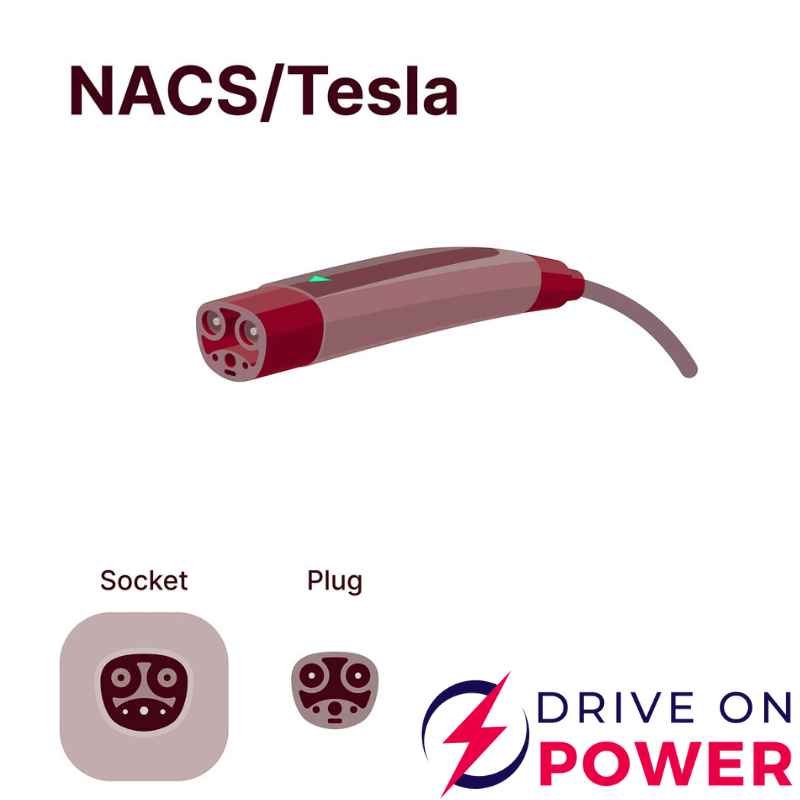
Tesla’s Switch to the NACS Connector Tesla has always done things a little differently, and now that includes how electric vehicles charge. The North American Charging Standard (NACS) is Tesla’s name for the charging plug it has used since 2012. What makes it unique is that it combines both AC (home charging) and DC (fast charging) into a single, slim 5-pin plug. Unlike other connectors that require separate plugs for slow and fast charging, NACS keeps it simple. In late 2022, Tesla officially opened up the NACS design for all automakers and charging networks. That move invited other brands to start using Tesla’s plug as a universal standard across North America. The big idea here is to create one plug for all EVs — replacing or supplementing the older Combined Charging System (CCS) standard that most non-Tesla vehicles currently use. Right now, all Tesla vehicles and Superchargers use the NACS plug exclusively. It’s designed for high power, with versions that handle 500V and even 1000V. Tesla’s latest Superchargers can pump out around 250–325 kW through this connector — that’s enough to add hundreds of miles of range in just 20–30 minutes. For regular home charging, the same plug supports 240V Level-2 power, up to about 48 amps (around 11.5 kW). So, in real-world driving, NACS and CCS offer similar charging speeds — but NACS is quickly becoming the go-to choice thanks to Tesla’s leadership and charging network size. If you’re just getting into EV charging at home, you might also want to check out our NEMA EVSE Charging Station Installation Guide (Wall, Pole, Pedestal Mounts) for a detailed breakdown of setup options. Why Tesla Opened NACS (and Why It Matters) Let’s be real — Tesla’s Supercharger network is already the largest and most reliable fast-charging system in the U.S. There are over 15,000 Tesla Supercharger stalls out there, which is about 60% more than all CCS charging stations combined. On top of that, more Teslas are on the road than any other EV brand — roughly a 2-to-1 ratio compared to CCS-equipped vehicles. With so many Tesla plugs already in place, it didn’t make sense to rip out or retrofit thousands of charging stations. Instead, Tesla chose a smarter approach: “change the car, not the station.” So they made their connector public and invited other automakers to build it into their vehicles. For Tesla owners, nothing changes — you’ll still plug in and charge as you always have. But now, non-Tesla EV drivers will soon be able to charge at Superchargers too. That’s a big win for everyone. It increases the number of people who can use the Tesla network and encourages automakers to promote their vehicles as “Supercharger compatible.” From a business perspective, Tesla gets more customers at their stations. And for drivers, it moves us closer to a universal charging setup — something that’s been missing in the EV world. Curious if your non-Tesla EV can use Tesla Superchargers? Don’t miss our guide: Can Any EV Use a Tesla Charger? Explained for New EV Owners. NACS vs. CCS: What’s the Real Difference? Here’s a straightforward look at how NACS stacks up against CCS: 1. Connector Design NACS uses one simple, compact plug for both AC and DC charging. CCS1 (used in the U.S.) combines a regular J1772 plug with two large DC pins, making it bulkier. NACS uses the same power pins for both charging types, which keeps the design lightweight and easier to handle. 2. Charging Speed Both systems are powerful. CCS1 is rated up to 1000 volts and 500 amps (around 360 kW), and NACS is right in the same ballpark. Tesla’s latest Superchargers currently deliver around 250–325 kW. That’s more than enough for most long road trips. For home charging, NACS handles standard 240V Level-2 speeds (up to 11.5 kW), same as CCS. 3. Charging Network This is where NACS really pulls ahead. Tesla’s network of Superchargers is widespread and well-maintained. As of early 2025, there are about 36,500 public fast-charging ports with NACS connectors in the U.S. — including Tesla Superchargers and third-party stations. By comparison, there are only about 17,000 CCS ports. So if you’re driving a NACS-equipped car, your charging options are much better. Feature NACS (Tesla Plug) CCS (Combined Charging System) Connector Size Slim, single-piece design Bulkier, two-piece (J1772 + DC pins) Charging Type AC and DC charging in one connector Separate pins for AC and DC Max Charging Power Up to 1000V / ~900A (~325 kW) Up to 1000V / 500A (~360 kW) Ease of Use Simple to plug in and handle Larger, can be heavier and trickier to insert Used By (2025+) Tesla, Ford, GM, Volvo, Hyundai, and more Some older EVs and certain non-Tesla chargers Charging Networks Tesla Superchargers + growing NACS support Electrify America, EVgo, and other CCS stations AC Home Charging Up to 240V, ~48A (~11.5 kW) Similar Level-2 support via J1772 Planning to set up your own home charging station? Read our step-by-step tutorial: How to Install a NEMA 14‑50 Outlet for Your EV Charger. What This Means for EV Drivers If You Own a Tesla: Nothing changes for you. Your vehicle already uses the NACS connector, and you’ll continue using Superchargers as usual. The main difference is that you might start seeing other EV brands using the same stations, which could lead to faster expansion of the network. If You Own a Non-Tesla EV With a CCS Port: You’ll need an adapter to charge at Tesla Superchargers. The good news is that automakers like Ford and GM started offering free CCS-to-NACS adapters in 2024 for vehicles like the Mustang Mach-E, F-150 Lightning, and Chevy Blazer EV. Tesla recommends using only official adapters, not third-party ones, to avoid safety issues. If You’re Buying an EV in 2025 or Later: Almost every new EV sold in the U.S. starting in 2025 will come with a built-in NACS port. Brands like Ford, GM, Volvo, Mercedes, Hyundai, Kia, and Lucid are all on board. That means you’ll